
Home Office Deduction: Who Qualifies and How to Claim It
A freelance editor measures her spare bedroom, tallies her utility bills, and wonders whether that corner of the house is worth a tax deduction or an audit question. It’s a fair question. The home office deduction can lower your tax bill, but only if your space and your records meet the IRS rules.
The good news is that the rules are clear once you break them down. You need the right kind of business, the right kind of space, and a calculation method that fits your situation.
This guide walks through each step for tax years 2025 and 2026. It covers who qualifies, how the tests work, and how to choose between the simplified and regular methods. You’ll also see how to report the deduction on Form 8829 and Schedule C.
What the Home Office Deduction Is and Who Can Claim It
The home office deduction lets you deduct expenses for the part of your home you use for business. The IRS calls this the business use of home. Depending on the method you choose, it can include a share of rent or mortgage interest, utilities, insurance, repairs, and depreciation.
Keep one point in mind from the start. This is a deduction, not a credit. It reduces your taxable business income, not your tax bill dollar for dollar. For example, a $2,000 deduction doesn’t save you $2,000 in tax. Your actual savings depend on your income tax bracket and self-employment tax.
Self-employed versus employee status
The main group who can claim the self-employed home office deduction is people who work for themselves. That includes sole proprietors, single-member LLC owners who report on Schedule C, and independent contractors who receive 1099s.
Employees are a different story. W-2 employees generally cannot claim the home office deduction on their federal return, even if they work from home full time. The deduction for unreimbursed employee expenses has been suspended since the 2018 tax year, and legislation passed in 2025 made that suspension permanent. Confirm the current rules in IRS Topic No. 509 or with a tax professional before you file.
Step One: Confirm Your Space Meets the Regular and Exclusive Use Test
The regular and exclusive use test is the foundation of the deduction. If your space fails either part, you generally can’t claim it, no matter how much work you do there.

What counts as regular use
Regular use means you use the space for business on a continuing basis. Occasional or incidental use doesn’t count. Working at a desk every weekday morning qualifies. Answering a few emails there once a month probably doesn’t.
What counts as exclusive use
Exclusive use means a specific, identifiable area is used only for business. The area doesn’t need walls or a door. However, any personal use in that same area can break the test. A dining table where the family eats dinner fails. So does a guest bed in the corner of your office.
Here’s a simple contrast. A bookkeeper converts a spare room into an office with a desk, filing cabinets, and a printer. Nobody else uses it. That room likely passes. Now picture a desk in the living room used for client work by day and kids’ homework at night. That space likely fails, because the use isn’t exclusive.
There are a few exceptions to exclusive use. One applies to space used to store inventory or product samples, under specific conditions. Another applies to certain daycare facilities. IRS Publication 587 spells out each exception and its requirements.
Finally, the space must be used for a trade or business. A room for a personal hobby, like a crafting studio that never earns money, doesn’t qualify.
Principal Place of Business: Where Administrative Work Counts
Passing the use test is only part of the picture. Your home office also needs to be your principal place of business, or a place where you regularly meet clients or customers.
Many owners assume this means they must do all their work at home. That’s not the case. Your home can qualify if it’s where you handle administrative or management activities, and you have no other fixed location where you do that work substantially.
Administrative and management activities
Administrative work covers the tasks that keep the business running. Common examples include:
- Sending invoices and following up on payments
- Doing bookkeeping and reconciling accounts
- Scheduling jobs and appointments
- Ordering supplies and equipment
- Answering client emails and calls
Consider a mobile dog groomer who works in clients’ driveways all day. She still handles booking, billing, and supply orders from her home office each evening. Her home can qualify as her principal place of business, even though the grooming happens elsewhere.
The same logic applies to consultants who work on-site or contractors who spend days at job sites. As long as the administrative work happens at home, client-site work doesn’t disqualify you. Keep simple notes about where these tasks happen. A short weekly log is enough to show your pattern if questions come up.
Home Office Deduction Requirements Checklist
Use this checklist to review the core home office tax deduction requirements before you claim anything. If you can’t check every box, talk to a tax professional first.
- Business type: You operate as a sole proprietor, a single-member LLC treated as a disregarded entity, or through another self-employment activity.
- Regular use: A specific area of your home is used for business on a continuing basis.
- Exclusive use: That area is used only for business, unless an IRS exception applies.
- Location test: Your home is your principal place of business, or you use the space to meet clients or customers in the normal course of business.
- Records: You have measurements for square footage, receipts for expenses, and notes that support business use.
- Current rules: You’ve confirmed the requirements for your filing year in Publication 587 or Topic No. 509 on IRS.gov.
Simplified Home Office Deduction vs. Regular Method: Which Fits You
Once you qualify, you choose how to calculate the deduction. The two options trade simplicity for potential savings.
The simplified home office deduction multiplies a set rate by your office’s square footage, up to a cap. For many years the rate has been $5 per square foot for up to 300 square feet, a maximum of $1,500. Confirm the current rate and cap in Publication 587 for the year you file. Under this method, you don’t deduct actual home expenses or depreciation.
The regular method uses your actual home expenses. You figure your business-use percentage, then apply it to costs like rent or mortgage interest, utilities, insurance, repairs, and depreciation.
| Factor | Simplified Method | Regular Method |
|---|---|---|
| Effort | Low: one multiplication | Higher: Form 8829 and expense allocation |
| Recordkeeping | Square footage and proof of qualifying use | Square footage plus receipts for all home expenses |
| Depreciation | None claimed | Claimed on the business portion, with recapture on sale |
| Typical fit | Small offices, renters with modest costs, owners who value simplicity | Larger offices, high housing costs, owners who keep detailed records |
Worked example with a 180-square-foot office
Say you rent a 1,200-square-foot apartment and use a 180-square-foot room as your office. Your business-use percentage is 180 ÷ 1,200 = 15 percent. Here’s how that applies to sample annual costs:
- Rent: $18,000 × 15% = $2,700
- Utilities: $3,000 × 15% = $450
- Renters insurance: $300 × 15% = $45
- Whole-home repairs: $800 × 15% = $120
The regular method totals $3,315. Using the $5 rate that has applied in recent years, the simplified method gives 180 × $5 = $900. In this case, the regular method yields a much larger deduction, subject to the gross income limit: the deduction generally can’t exceed the income your business earns from using the home, and under the regular method any disallowed amount can carry forward to a later year.
You can generally choose a method each year. However, switching has rules, especially around depreciation, so check Publication 587 before you change.
How to Calculate and Report the Regular Method on Form 8829
If you choose the regular method, you’ll use Form 8829 home office reporting. Some tax software works like a home office deduction calculator and fills in the form for you. Still, it helps to understand what the numbers mean.
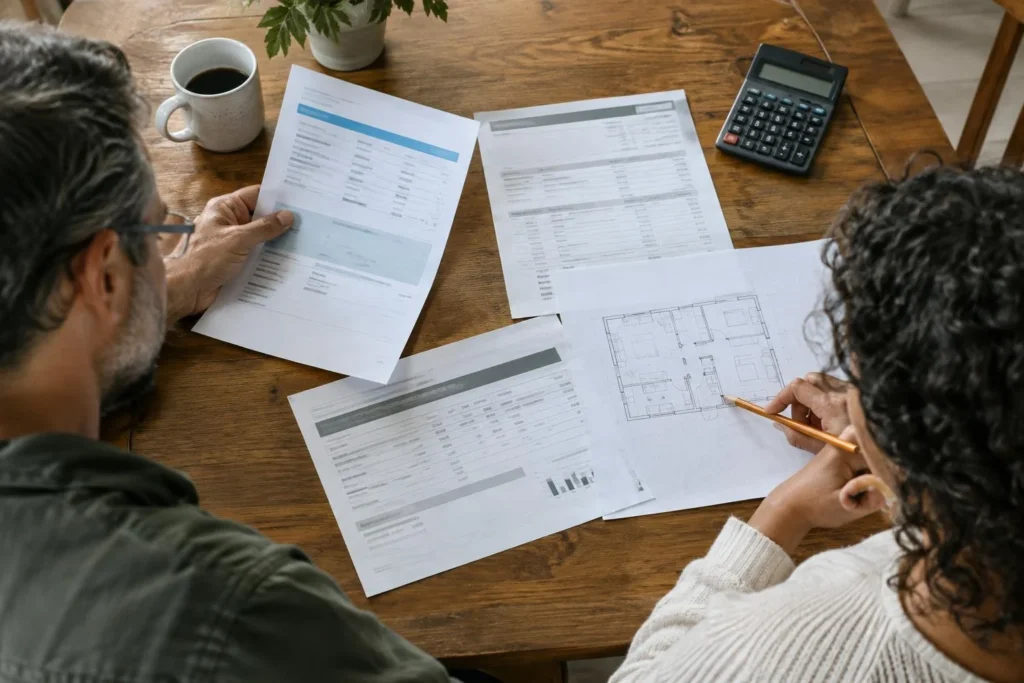
Business-use percentage
- Measure your office. Multiply length by width for the business area. Save the measurements or a simple floor sketch.
- Measure your home. Use the total finished square footage. A lease, appraisal, or your own measurements can support this figure.
- Divide. Office square footage ÷ total square footage = business-use percentage. If your rooms are roughly the same size, the IRS instructions allow dividing by the number of rooms instead.
Sorting your expenses
- Separate direct and indirect expenses. Direct expenses benefit only the office, such as painting or repairing that room. These are generally deductible in full. Indirect expenses benefit the whole home, such as rent, mortgage interest, real estate taxes, utilities, insurance, and general repairs. These are multiplied by your business-use percentage.
- Exclude unrelated costs. Expenses for parts of the home you don’t use for business, like landscaping or a kitchen remodel, generally aren’t deductible here.
Completing Form 8829
- Part I figures the part of your home used for business, which is your percentage.
- Part II lists your direct and indirect expenses and applies the income limit to find your allowable deduction.
- Part III calculates depreciation on the business portion if you own your home.
- Part IV tracks any expenses you couldn’t deduct this year so you can carry them forward.
Where the result goes on Schedule C
For sole proprietors, the allowable amount from Form 8829 flows to the business-use-of-home line on Schedule C. Under the limitation rules in Publication 587, the deduction generally can’t create or increase a business loss. Disallowed amounts may carry over to future years. Line numbers can change, so confirm current instructions on the About Form 8829 page on IRS.gov.
If you own your home, the personal share of mortgage interest and property taxes may still be deductible on Schedule A if you itemize. A tax professional can help you split these correctly.
Common Home Office Mistakes That Trigger IRS Questions
Most problems with the home office deduction come from weak records or stretched rules. Here are the mistakes we see most often.
Claiming a shared room. A spare room that doubles as a guest room or playroom fails the exclusive use test. If family members use the space, it generally doesn’t qualify.
Guessing the square footage. An inflated or unmeasured figure is hard to defend. Measure the office and the home, then keep a dated note or floor sketch with your tax records.
Deducting 100 percent of shared costs. Utilities and internet that serve the whole household can’t be deducted in full as home office costs. Apply your business-use percentage, or document a reasonable business-use share for services like internet.
Skipping the paper trail. Receipts, bills, and a simple log support your numbers. Without them, an IRS question becomes much harder to answer. Our year-end bookkeeping checklist can help you gather these documents before tax season.
Mixing methods incorrectly. You can’t claim both the simplified and regular methods for the same space in the same year. Pick one and apply it consistently for that year.
The U.S. Small Business Administration encourages owners to keep business and personal finances separate. Following that habit makes your home office records cleaner and easier to defend.
Selling Your Home: Depreciation Recapture Considerations
If you use the regular method and own your home, you’ll claim depreciation on the business portion. That depreciation reduces your home’s basis. When you sell, it can become taxable.
This catches many owners by surprise. Even if the rest of your gain qualifies for the home sale exclusion, the depreciation portion generally does not. It may be taxed separately in the year of sale.
Track the depreciation you claim each year and keep copies of every Form 8829. Before you list your home, ask a tax professional to estimate the impact. Publication 587 explains how the sale rules interact with business use.
Note: Tax rules and figures can change from year to year. The information in this article applies to tax years 2025 and 2026 as described. Confirm details for your situation on IRS.gov or with a qualified tax professional before you file.
Take the Next Step: Measure, Gather Records, and Confirm Your Method
- Measure and sketch. Record the office’s square footage and your home’s total square footage. Draw a simple floor plan and keep it with your tax records.
- List 12 months of expenses. Collect rent or mortgage interest, utilities, insurance, and repairs. Our year-end bookkeeping checklist can help you organize them.
- Run both methods. Use the current rates in Publication 587 to compare the simplified and regular results.
- Confirm before filing. Review your choice with a qualified tax professional, because individual circumstances vary.
- Check IRS.gov. Verify the rules for the specific tax year you’re filing, whether 2025 or 2026.
Related reading
- Payroll Services for Startups Secure and Easy Solutions
- Payroll Outsourcing Services to Save Time and Reduce Errors
- Trusted Payroll Processing Company with Expert Solutions
Frequently Asked Questions
Can an S corp owner take the home office deduction?
Not in the usual way. S corporation owners who work in the business are employees of the corporation, so they generally cannot deduct home office costs on their personal return. Instead, the S corporation can reimburse the owner for qualifying home office expenses under an accountable plan, and the corporation deducts the reimbursement. Set this up with your tax professional.
Is there a working from home tax deduction for employees?
Not on a federal return for most W-2 employees. The deduction for unreimbursed employee expenses, including a home office, has been suspended since 2018 and was made permanent by 2025 legislation. Self-employed people who meet the IRS requirements can still claim the home office deduction. Some states have different rules.
Can I claim a home office deduction if I work for an employer and have a home office?
Generally, no. W-2 employees can’t deduct unreimbursed home office expenses on their federal return, even if they work from home full time. That suspension began in 2018 and is now permanent. You may be able to get reimbursed through your employer’s expense policy instead. See Topic No. 509 for a summary of who qualifies.
What is the difference between the simplified home office deduction and the regular method?
The simplified method multiplies your office square footage by a flat IRS rate, up to a set maximum area. It requires less recordkeeping and involves no depreciation. The regular method uses your actual home expenses, including depreciation, multiplied by your business-use percentage, and is reported on Form 8829. The regular method often takes more work but can produce a larger deduction for higher-cost homes.
Does a home office have to be used only for business to qualify?
In most cases, yes. The space must be used regularly and exclusively for your business. A guest room that doubles as an office, or a kitchen table you work at, usually won’t qualify. Publication 587 describes limited exceptions, such as certain daycare facilities and space used to store inventory or product samples.
Do I still qualify if I meet clients at another location but do my invoicing at home?
You may. Your home office can count as your principal place of business if you use it for administrative or management tasks, such as invoicing, scheduling, and bookkeeping. You must also have no other fixed location where you do substantial administrative work. The space still needs to meet the regular and exclusive use test.
Will claiming the home office deduction affect my taxes when I sell my house?
It can if you use the regular method. Depreciation you claimed, or could have claimed, generally must be recaptured and taxed when you sell, even if the rest of your gain is excluded. The simplified method doesn’t involve depreciation, so recapture doesn’t apply for the years you used it. Talk with a tax professional before selling so you understand the impact.
The home office deduction is much easier to claim when your records are organized all year. If you’d like help keeping your books accurate and current, SteadyBooks can support your bookkeeping, payroll, and day-to-day finances, so you can spend more time running your business.
This article is general educational information based on rules for 2025, 2026, not tax, legal, or accounting advice. Rules and thresholds change, so confirm details for your situation with the IRS or your state agency, or with a qualified professional.