
Form 1120-S Explained: How S Corporations File Their Tax Return
A shareholder who never saw a Schedule K-1 before the deadline can end up guessing at income the company already reported. That is one reason S corp owners need to understand this return before March arrives. Form 1120-S is where the company reports its income, and every shareholder’s personal return depends on it.
The good news is that the return follows a logical order. Once you know what each part does, you can keep better books all year and give your preparer what they need.
This guide covers who files, when it is due for the 2025 tax year (filed in 2026), and how payroll and shareholder basis tie in. It ends with a year-end checklist and the errors worth catching before you file.
What Form 1120-S Is and Who Must File It
Form 1120-S is the federal S corporation income tax return. It reports the company’s income, deductions, credits, and shareholder information each year. The IRS page for Form 1120-S covers its purpose and filing requirements.
A corporation becomes an S corporation by filing Form 2553. It must also meet eligibility rules. These include a limited number of shareholders, only eligible shareholder types, and one class of stock. If you are still weighing the election, our guide to C corp vs S corp taxes and ownership walks through the trade-offs.
Why the S corporation return is an information return
In most cases, an S corporation does not pay federal income tax itself. Instead, profits and losses pass through to the shareholders. Each owner reports their share on their personal return.
So the return mainly tells the IRS how much the business earned and who it belongs to. Even so, it is required every year the election is in effect. That holds even if the company owes nothing at the entity level, or had a loss.
When the entity pays tax anyway
A few situations can create tax at the corporate level. The best known are the built-in gains tax and the excess net passive income tax. Both mostly affect companies that were once C corporations.
These rules are technical. Check the current 1120-S instructions to see whether either applies to you.
Form 1120-S Deadlines, Extensions, and Penalties
Missing the S corp tax filing deadline affects more than the company. It can also delay every shareholder’s personal return.
Due dates for calendar-year filers
An S corporation generally files by the 15th day of the third month after its tax year ends. For calendar-year companies, that is March 15. When the date falls on a weekend or legal holiday, the deadline moves to the next business day.
For the 2025 tax year, March 15, 2026 falls on a Sunday. That means the due date moved to Monday, March 16, 2026. For the 2026 tax year, the return is due Monday, March 15, 2027. Confirm the date on the IRS small business page before you plan around it.
Fiscal-year corporations use the same rule, counted from the end of their own tax year.
Automatic six-month extension with Form 7004
Need more time? File Form 7004 by the original due date. That gives you an automatic six-month extension to file.
However, an extension to file is not an extension to pay. If the corporation owes any entity-level tax, payment is still due by the original deadline.
Penalties apply when the return is late or K-1s are late or incorrect. They are generally calculated per shareholder, per month, and adjusted for inflation each year. A three-owner company that files two months late faces a penalty multiplied by six shareholder-months. Check IRS.gov for the current amount.
How Form 1120-S Differs from Schedule C and Form 1065
Your business structure determines which return you file and which tax forms owners receive. Here is how the three most common small business returns compare.
Comparison at a glance
| Feature | Schedule C | Form 1065 | Form 1120-S |
|---|---|---|---|
| Who files | Sole proprietors and single-member LLCs taxed by default | Partnerships and multi-member LLCs taxed as partnerships | Corporations and LLCs with a valid S election |
| Separate business return? | No, it attaches to the owner’s Form 1040 | Yes | Yes |
| Where income flows | Directly onto the owner’s personal return | To partners via Schedule K-1 | To shareholders via Schedule K-1 |
| Owner tax form from the business | None | Schedule K-1 (Form 1065) | Schedule K-1 (Form 1120-S), plus a W-2 for shareholder-employees |
| Owner on payroll? | Generally no | Generally no; partners are not employees | Yes, if the owner works in the business |
With an S corporation, the company files Form 1120-S. Each owner then receives a Schedule K-1 showing their share of income, deductions, and credits. Owners report those amounts on their personal returns.
The biggest practical difference is payroll. An S corporation with working owners pays them wages and issues W-2s. A sole proprietor filing Schedule C does not put themselves on payroll.
For the partnership side, see our guide to how partnerships and multi-member LLCs file Form 1065.
Walking Through the Main Parts of Form 1120-S
The form moves from income, to deductions, to shareholder-level detail. Line numbers can change between years, so follow the 1120-S instructions for the year you are filing.
Income and deductions (page 1)
Page 1 calculates ordinary business income or loss. Here is the basic flow:
- Enter gross receipts. This is total sales or fees for the year.
- Subtract returns and allowances. These include refunds and discounts given to customers.
- Subtract cost of goods sold. This applies if you sell products. A service business often has none.
- Add other income. Examples include certain gains from selling business property.
- List deductions. Key lines cover officer compensation, salaries and wages, rent, taxes and licenses, depreciation, and other deductions.
- Calculate ordinary business income or loss. This is total income minus total deductions.
Here is an example. A consulting firm earns $180,000 in receipts. It has no cost of goods sold and $60,000 in deductible expenses, including payroll. Its ordinary business income is $120,000. If two owners each hold 50%, each K-1 shows $60,000 of ordinary income.
Officer compensation must match your payroll records. Larger corporations may also need to attach a separate form detailing officer pay. Check the instructions.
Shareholder information and balance sheet
The later schedules cover shareholders, the balance sheet, and reconciliation:
- Schedule B: Yes-or-no questions about the company. Topics include its accounting method, ownership of other entities, and whether certain size tests are met.
- Schedule K: Totals for all shareholders. It lists ordinary income and separately stated items such as charitable contributions, credits, and certain investment income.
- Schedule L: The balance sheet at the beginning and end of the year.
- Schedule M-1 or M-3: A reconciliation of book income to taxable income. Larger corporations use M-3.
Smaller corporations that meet certain receipts and asset tests may not need Schedules L and M-1. Confirm the current thresholds in the 1120-S instructions.
Reasonable Compensation and Payroll Reconciliation
Payroll is where many S corp returns go wrong. It is also an area the IRS watches closely.
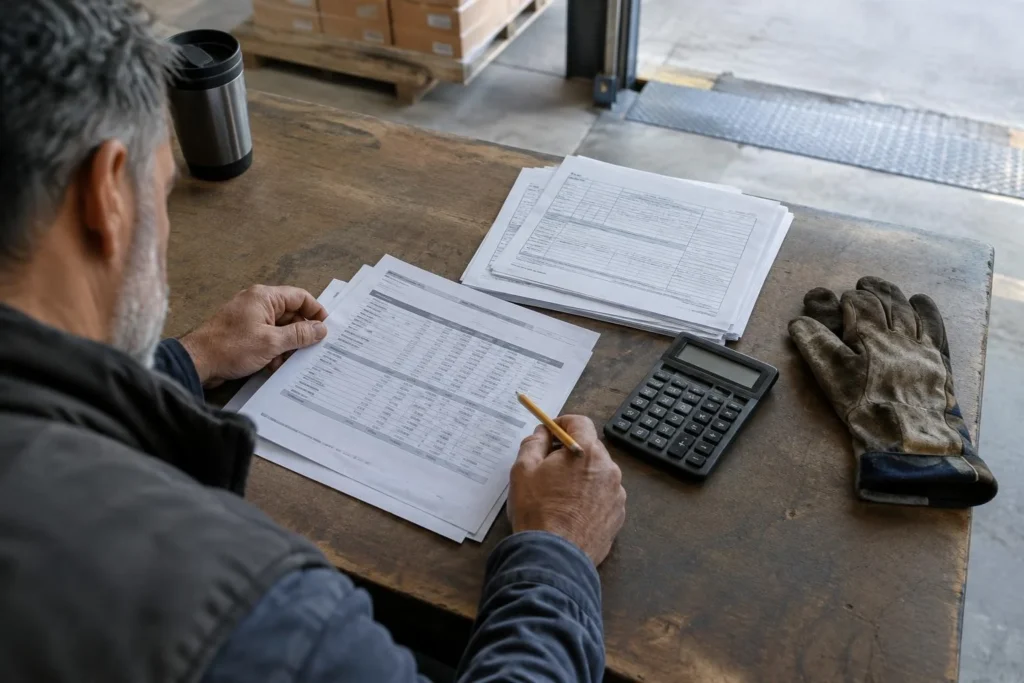
What the IRS expects for officer pay
A shareholder who performs substantial services for the company is treated as an employee. They must receive reasonable compensation through payroll. That pay is subject to employment taxes and reported on Form W-2.
What counts as reasonable? It depends on the facts. Factors include job duties, time spent, training and experience, and what similar businesses pay for comparable work. The IRS S Corporations page covers this topic in more detail.
Shareholder distributions are different. They are generally not subject to employment tax. However, they should be made in proportion to ownership. Paying a 60% owner and a 40% owner equal distributions could create problems with the one-class-of-stock rule.
Tying payroll to the return
Before the return is prepared, run this reconciliation:
- Pull total W-2 wages from your payroll system.
- Split those wages between officers and other employees.
- Match officer wages to the officer compensation line. Match the rest to salaries and wages.
- Confirm that your four quarterly Forms 941 add up to the year’s payroll totals.
- Check that Form 940 agrees with your taxable wages for federal unemployment. Our Form 940 guide explains that return.
If the numbers do not match, find the cause before filing. Common culprits are timing issues and owner health insurance.
Shareholder Basis and Schedule K-1 Preparation
Basis tracking is a shareholder responsibility. In practice, though, it depends on good company records.
Stock basis and debt basis explained
Stock basis measures a shareholder’s investment in the company. It starts with what they paid for the stock or contributed. Basis then increases with income and new contributions. On the other hand, it decreases with distributions, losses, and nondeductible expenses.
Basis matters for two reasons. First, a shareholder can only deduct losses up to their basis. Second, distributions are generally tax-free up to basis. Amounts beyond basis are generally taxable, usually as capital gain.
Shareholder loans can create separate debt basis. This applies when the shareholder lends money directly to the company. Personally guaranteeing a bank loan generally does not count. Shareholders may need to attach Form 7203 to their personal returns, so check the current instructions.
Building each K-1
Use this workflow for each Schedule K-1 S corporation shareholders receive:
- Confirm each owner’s ownership percentage, including any changes during the year.
- Allocate ordinary income and each separately stated item based on shares held.
- Update a basis schedule for every owner. Carry it forward each year.
Every shareholder receives Schedule K-1 (Form 1120-S). The K-1 is generally due to shareholders by the return’s due date, including extensions. Basis rules have many exceptions, so confirm the details with a qualified tax professional.
Year-End Bookkeeping Workflow for Your S Corp Return
Close these items before your preparer starts the return.

Books and balances
- Bank and credit card accounts reconciled through December 31
- Accounts receivable and payable aging reviewed and cleaned up
- Fixed asset and depreciation schedules updated (see our guide to depreciation methods for small businesses)
- Loan balances matched to lender statements
Payroll
- Final quarterly payroll reports filed
- W-2 totals confirmed
- Owner health insurance and retirement contributions tracked separately
- Shareholder loan and distribution logs complete
Ownership
- Shareholder percentages current
- Capital contributions recorded
- Distributions recorded by owner
- Basis schedule updated
Finally, review the year-end profit and loss statement and balance sheet with your preparer before filing.
Common Form 1120-S Errors to Catch Before Filing
Check for these before you sign the return:
- Officer pay mismatch. Officer compensation on the return does not match W-2 totals.
- Misclassified payments. Distributions are booked as wages, or wages as distributions. This affects employment taxes, deductions, and basis.
- Wrong K-1 percentages. Allocations do not match actual ownership.
- Stale basis. Basis was never updated after a loan, contribution, or distribution.
- Missed extension. Form 7004 was not filed by the original due date.
- Late K-1s. Shareholders did not receive their K-1s on time.
- Mixed expenses. Personal costs ran through the business, which distorts both income and basis. A solid receipt tracking system helps prevent this.
Take the Next Step Before Your Filing Deadline
Start this week. Pull last year’s Form 1120-S and every shareholder’s K-1. Compare them line by line to your current books, and flag anything that changed: owner wages, distributions, loans, or new assets. Then list each open item on one page with an owner and a target date.
Before you file, confirm current due dates, extension rules, and penalty amounts on IRS.gov. For entity-specific decisions, consult a qualified CPA or enrolled agent. Finally, book a year-end review with your bookkeeper or tax preparer early in the calendar year, while there’s still time to fix problems.
Frequently Asked Questions
What is the due date for Form 1120-S for a calendar-year S corporation?
Form 1120-S is generally due on the 15th day of the third month after the tax year ends. For a calendar-year S corp, that means March 15. If that date falls on a weekend or legal holiday, the deadline moves to the next business day. For example, March 15, 2026 is a Sunday, so check IRS.gov for the confirmed 2025 tax year due date.
Can an S corporation get more time to file Form 1120-S?
Yes. An S corporation can request an automatic six-month extension by filing Form 7004 by the original due date. The extension gives you more time to file, not more time to pay any tax the entity owes. Shareholders may also need extensions for their personal returns if K-1s arrive late.
Does an S corporation owner receive a W-2 and a Schedule K-1?
Usually, yes. An owner who works in the business should be paid reasonable compensation through payroll and receive a W-2 for those wages. That same owner also receives a Schedule K-1 showing their share of the company’s income, deductions, and credits. Both documents go on the owner’s personal return.
What is shareholder basis, and why does it affect my S corp taxes?
Basis is roughly your investment in the S corp. It starts with what you contributed, rises with your share of income, and falls with losses and distributions. It matters because you generally can’t deduct losses beyond your basis. Distributions that exceed basis are usually taxed as capital gains. Track it every year, not just when a problem shows up.
Do S corporations pay income tax at the entity level?
Generally, no. Income passes through to shareholders, who pay tax on it through their personal returns. There are exceptions, such as the built-in gains tax and the tax on excess net passive income, which mainly affect former C corporations. Some states also charge entity-level taxes or fees. For a broader comparison, see our guide to C corp vs S corp taxes and ownership. The IRS S corporations overview is another good starting point.
This article is for general information about the 2025 and 2026 tax years. Tax rules change, so confirm details with a qualified CPA or enrolled agent before you file.
A clean Form 1120-S starts with clean books all year long. If you’d rather not untangle payroll, distributions, and basis every spring, SteadyBooks can help with bookkeeping, payroll, and day-to-day financial support. That way you can focus on running your business and hand your tax preparer records that are ready to go.
This article is general educational information based on rules for 2025, 2026, not tax, legal, or accounting advice. Rules and thresholds change, so confirm details for your situation with the IRS or your state agency, or with a qualified professional.