
Fixed vs Variable Costs: Examples and Pricing Impact
Picture a candle maker who prices every jar to cover only the wax and wick and discovers at year end that the rent, insurance and software bills were never covered. Each sale looked profitable, yet the business lost money. This is a common pricing mistake, and it starts with not understanding fixed vs variable costs.
The fix is not complicated. You sort your expenses into two groups, work out what each sale really costs, and then set prices that cover everything. You don’t need an accounting degree, just a few months of records and a simple spreadsheet.
This guide walks through one sample business from start to finish. By the end, you will know your price floor, your break-even point and how to check a discount before you offer it.
Why the Split Between Fixed and Variable Costs Matters
Go back to the candle maker. Say each jar uses $4 of wax, wick and glass, and she sells it for $8. On paper, she earns $4 per jar. But her studio rent, insurance and shop software come to $2,000 a month. If she sells 300 jars, she earns $1,200 toward bills of $2,000. That leaves her $800 short every month.
Most small business expenses fall into two groups. Some stay flat no matter how much you sell. Others move up and down with each sale. That split drives two key numbers: the price you charge and the sales volume you need to break even.
Below, we build a worked example for a sample candle shop. We also set up spreadsheet formulas you can copy for your own business.
Fixed vs Variable Costs: The Core Difference
Fixed costs stay the same over a range of output within a set period, usually a month. Rent is the classic example. Whether you make 50 jars or 500, the landlord charges the same amount.
Variable costs rise or fall in proportion to sales or production. Make twice as many candles and you buy roughly twice as much wax. Make none and you buy no wax at all.
However, the labels only hold within a “relevant range” and time frame. Rent is fixed until your studio is full. If demand grows enough that you lease a second workshop, your fixed costs jump to a new level. Over a long enough period, almost any cost can change.
| Cost type | Behavior as volume changes | Test question to ask |
|---|---|---|
| Fixed | Stays the same in total each month; cost per unit falls as volume rises | “Would I still pay this if I sold nothing this month?” |
| Variable | Rises and falls in total with volume; cost per unit stays about the same | “Does this cost go up when I make or sell one more unit?” |
| Mixed | Has a flat base plus a part that moves with usage | “Is there a minimum charge, with extra on top for more use?” |
Together, your fixed and variable expenses make up your cost structure. That structure is the foundation of small business planning, from budgets to pricing to growth decisions.
Fixed Costs Examples in a Sample Candle Business
To keep the math concrete, meet Maple & Pine Candle Co. This is a hypothetical, home-based shop that rents a small studio space for pouring and storing candles. All figures below are illustrative, not industry benchmarks.

Walking through the sample business’s monthly fixed costs
Here is what Maple & Pine pays every month, regardless of sales:
- Studio rent: $850
- Online shop software subscription: $50
- Business insurance premium: $100 (a $1,200 annual premium divided by 12)
- Equipment loan payment: $300
- Part-time helper paid a set monthly amount: $700
That adds up to $2,000 in fixed costs per month. One note on the loan: only the interest portion appears as an expense on your profit and loss statement. Still, the full payment is a fixed cash outflow, so include it when you plan prices.
Fixed costs don’t pause in a slow month. If January sales drop to zero, Maple & Pine still owes $850 in rent. A missing month of sales does not shrink the bill. This is why fixed costs need to be built into every price, not just covered in good months.
What fixed costs do not include
Fixed costs exclude anything tied to each unit, such as wax or shipping boxes. They also exclude costs that only look fixed for part of the year.
For example, suppose Maple & Pine hires a seasonal helper for November and December on a flat monthly contract. During those two months, that cost is fixed. Across the full year, though, it comes and goes with the busy season. Treat it as fixed only in the months it applies, and leave it out of your other monthly budgets.
Variable Costs Examples and How to Track Them Per Unit
Variable costs are where pricing starts. If you don’t know what one unit costs, you can’t know whether a sale makes money.
Per-unit cost examples
For Maple & Pine, variable costs include:
- Wax
- Wicks
- Glass jars
- Labels
- Shipping materials such as boxes and padding
- Payment processing fees
- Sales commissions, if a sales rep or marketplace takes a cut
The first five are product costs that often feed into your cost of goods sold calculation. The last two are tied to each sale rather than each jar made.
Calculating variable cost per unit
Follow these steps using one month of records:
- Total your production costs for the month. In a month when it made 400 jars, Maple & Pine spent $520 on wax, $40 on wicks, $600 on jars, $80 on labels and $360 on shipping materials. Total: $1,600.
- Divide by units produced. $1,600 ÷ 400 jars = $4.00 per jar.
- Add per-sale costs separately. Card processing fees are usually a percentage of the sale plus a flat fee per transaction. Using a hypothetical rate of 3.5% plus $0.30, a $20 candle costs $0.70 + $0.30 = $1.00 to process. Check your own processor’s statement for your actual rates.
- Add any commissions. Maple & Pine sells direct, so commissions are $0 for now. If a rep took 10% of a $20 sale, that would add $2.00.
- Add it all up. $4.00 + $1.00 = $5.00 variable cost per jar.
Keep the percentage and flat parts of fees separate in your spreadsheet. The percentage part changes whenever your price changes, while the flat part does not.
How to Classify Messy Expenses Like Phone Bills and Utilities
Real books are rarely tidy. A good starting point is your general ledger or chart of accounts. Go line by line and sort each account into recurring overhead (fixed) or per-unit cost (variable). Most accounts sort easily. A few won’t.
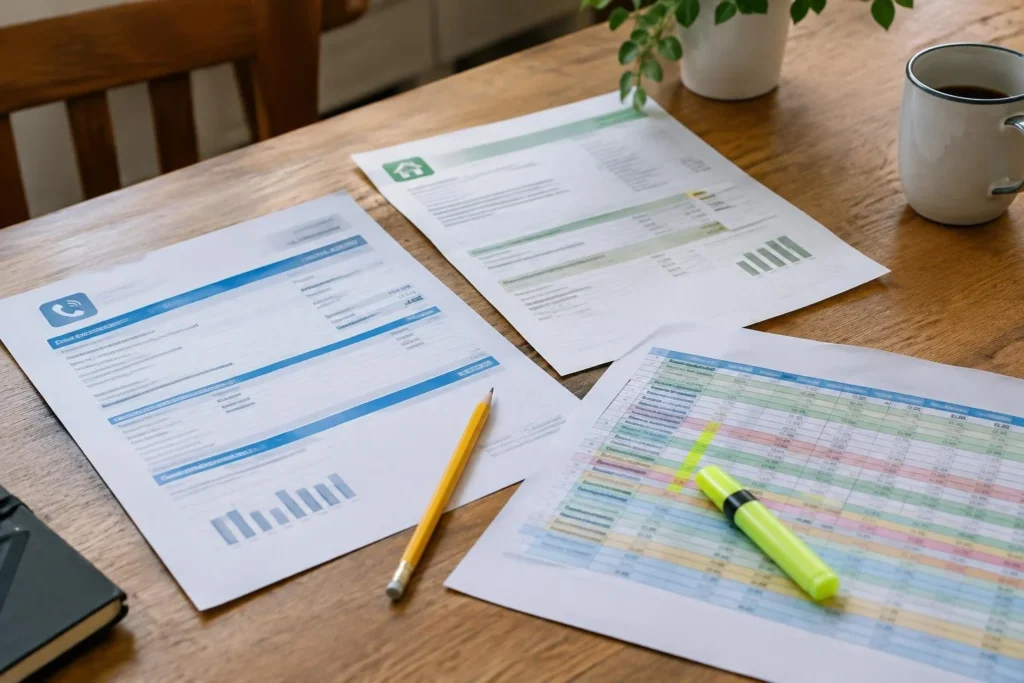
The tricky ones are mixed expenses. A business phone bill might include a flat $45 plan fee plus $15 in extra usage charges. A studio electric bill might carry a $20 base connection charge plus metered use that climbs when you melt more wax. Each bill contains both a fixed and a variable piece.
Use this checklist to sort them out:
- Pull the last three to six months of bills or ledger entries for each account.
- Mark any amount that stays flat every month, such as a base fee or plan charge. That is your fixed portion.
- Isolate the usage-based amounts that move up and down. That is your variable portion.
- Compare usage to production. If the electric bill rises in high-output months, treat the usage part as variable.
- Estimate a business-use percentage if the cost is shared with personal use, such as a home internet plan.
- Write down the rule you used, so you classify the same way every month.
A simple rule works well for most owners: split the bill into its fixed base and its variable usage portion. For the electric bill, that means $20 goes to fixed costs, and the metered portion is spread across units produced. Document the split once and reuse it. A steady weekly system for tracking business expenses makes these patterns much easier to spot.
Keep in mind that this classification is for pricing and planning only. Whether an expense is tax deductible is a separate question with its own rules. For that, start with the IRS small business and self-employed resources and confirm the details with a qualified tax professional.
How to Calculate Fixed Costs for Your Monthly Budget
Once your expenses are sorted, totaling fixed costs takes three steps:
- List every recurring flat expense. Include rent, subscriptions, insurance, loan payments, salaries and the fixed base of any mixed bill.
- Convert non-monthly bills to a monthly amount. Divide annual bills by 12 and quarterly bills by 3. A $1,200 annual premium becomes $100 a month.
- Add them together. This is your total monthly fixed cost.
In a spreadsheet, use one row per expense. Put the name in column A, the billing frequency in column B, the bill amount in column C and the monthly amount in column D. Then total column D with a SUM formula. Our small business budget template guide shows a fuller version of this layout.
Here is the cost-structure summary for Maple & Pine at 400 jars a month:
| Item | Amount |
|---|---|
| Total monthly fixed costs | $2,000 |
| Variable cost per unit | $5.00 |
| Total variable costs (400 jars × $5.00) | $2,000 |
| Ratio of fixed to variable spending | 1 : 1 (50% fixed, 50% variable) |
For broader guidance on tracking business costs, the U.S. Small Business Administration’s financial management resources on its website are a useful general starting point.
Contribution Margin and the Break-Even Point Formula
With fixed and variable costs in hand, you can answer the big question: how many sales do you need to stop losing money?
Calculating contribution margin per unit
Contribution margin per unit is your selling price minus your variable cost per unit. It’s the amount each sale “contributes” toward fixed costs and, after those are covered, toward profit.
Maple & Pine sells each candle for $20. Its variable cost is $5.00 per jar. So the contribution margin is $20 − $5 = $15 per jar. For more examples, see our guide to contribution margin formulas and pricing decisions.
Applying the break-even units formula
The break-even point formula is:
Break-even units = Total fixed costs ÷ Contribution margin per unit
For Maple & Pine, that is $2,000 ÷ $15 = 133.3 jars. You can’t sell a third of a candle, so round up to 134 jars a month. At $20 each, that is about $2,680 in monthly sales. Every jar sold beyond 134 adds $15 to profit.
Contribution margin is a powerful lever. If Maple & Pine cut its variable cost to $4 per jar, the margin would rise to $16. Break-even would drop to 125 jars. In other words, a higher margin means fewer sales are needed to cover the same fixed costs.
If you want a second set of eyes on your numbers, SCORE offers free mentoring and business planning resources, including break-even tools. A mentor can help you test your assumptions.
Pricing Based on Variable Costs: Setting a Price Floor
Your price floor is the lowest price that covers your variable cost per unit. For Maple & Pine, that is $5.00. Below that, every sale loses money before rent is even considered. Even at the floor, though, nothing goes toward fixed costs, so it’s never a sustainable long-term price.
Use these steps to move from the floor to a realistic price:
- Start with the floor. Variable cost per unit: $5.00.
- Add a share of fixed costs. Divide fixed costs by your target monthly units. At 400 jars, $2,000 ÷ 400 = $5.00 per jar.
- Find your full-cost price. $5.00 + $5.00 = $10.00. At 400 jars, this covers every cost but earns no profit.
- Add your profit target. Maple & Pine’s $20 price leaves $10 per jar above full cost at 400 jars. Note that a lower price also lowers the percentage-based processing fee slightly, so recalculate variable cost whenever you test a new price.
- Build it in a spreadsheet. Put fixed costs in B1, variable cost per unit in B2, target units in B3 and selling price in B4. Then use these formulas:
- Price floor: =B2
- Full-cost price: =B2+B1/B3
- Contribution margin: =B4-B2
- Break-even units: =ROUNDUP(B1/(B4-B2),0)
Be careful with discounts. A 25% sale drops the $20 candle to $15. Holding variable cost at $5 for simplicity, the margin falls from $15 to $10. Break-even jumps from 134 jars to 200 jars. Never discount below the floor, and always check how a discount changes your margin and monthly break-even first.
Finally, confirm any pricing decision against your current financial reports and accounting records. Costs drift over time, so the numbers behind your price should come from your latest books, not last year’s estimates.
Build Your Cost Sheet Before Your Next Price Change
Start with one task this week. Pull every expense from the last three months and tag each one as fixed, variable or mixed. If your records are scattered, a simple weekly system for tracking business expenses makes this much easier next time.
Next, set up the break-even formula in a spreadsheet using your own numbers. Then test a few price changes before you announce one.
Keep in mind that cost behavior is a planning tool. How an expense is treated for taxes is a separate question. The IRS small business and self-employed section is the official place to start. A qualified tax professional or bookkeeper can confirm the details for your situation.
Frequently Asked Questions
What is the difference between fixed costs and variable costs?
Fixed costs stay roughly the same each month no matter how much you sell, such as rent, insurance and software subscriptions. Variable costs rise and fall with sales volume, such as raw materials, packaging and payment processing fees. Knowing which is which shows you how your profit changes as sales go up or down.
Is rent always a fixed cost for a small business?
Usually, yes. A standard lease charges the same amount each month regardless of sales. However, some retail leases add a charge based on a percentage of sales, which makes part of the rent variable. Also, rent is only fixed for the length of the lease, so treat renewals as a chance to revisit your cost structure.
How do I classify a phone bill that has both a base fee and usage charges?
Treat it as a mixed cost and split it into two parts. The base monthly fee goes in your fixed costs. Any usage charges that rise with business activity go in variable costs. If the usage portion is small and steady, many owners simply treat the whole bill as fixed for budgeting.
What is contribution margin and how is it used to find the break-even point?
Contribution margin is your selling price minus the variable cost per unit. It is the amount each sale contributes toward covering fixed costs. To find break-even, divide total monthly fixed costs by the contribution margin per unit. For example, if a product sells for $20 with $8 in variable costs, each sale contributes $12, and $3,000 in fixed costs means you need 250 sales to break even.
Does the fixed or variable classification affect how an expense is deducted on taxes?
Not directly. Fixed and variable are management labels that describe how a cost behaves. Tax treatment depends on other rules, such as whether the expense is a business expense, part of inventory costs, or a purchase that must be depreciated. Check the IRS small business resources and confirm specifics with a qualified tax professional.
Accurate cost tracking starts with clean, up-to-date books. If you would rather spend your time running the business than sorting expenses, SteadyBooks can help with bookkeeping, payroll and day-to-day financial support, so you have reliable numbers ready for your next pricing decision.