
Petty Cash: How to Set Up and Track a Petty Cash Fund
A $20 cash shortage at the end of the month is easy to ignore until nobody can explain where the money went. Then it happens again, and the gaps add up. A simple petty cash system prevents that by giving every dollar a clear trail from the box to your books.
This guide walks you through setting up a fund, recording each payment, refilling the box, and reconciling it every month. You’ll get a copyable log template, worked examples with real numbers, and a checklist you can use right away.
The process takes about an hour to set up. After that, it needs only a few minutes a week.
What a Petty Cash Fund Is and When You Need One
Why cash still matters for small purchases
Petty cash is a small, fixed amount of cash kept on hand to pay minor business expenses. Typical uses include postage, coffee supplies, parking, or a last-minute part from the hardware store. These purchases are too small to justify a check or a formal purchase order.
The key word is fixed. You don’t top up the box by pulling cash from the bank whenever it runs low. Instead, you refill it with a single check or transfer that matches the receipts already spent. As a result, your bank statement shows one clean replenishment rather than a string of unexplained ATM withdrawals.
When a petty cash fund is the right tool
A fund makes sense when you regularly deal with vendors that only take cash, such as a parking lot, a farmers market, or a local courier. It also helps with tiny reimbursements, like paying back an employee $6 for printer paper.
However, a business debit or credit card often works better. Cards create an automatic record and are easier to reconcile. If most of your small purchases happen online or at stores that accept cards, you may not need petty cash at all.
One expectation before you start: the system only works if every dollar leaving the box has a record behind it. No receipt or voucher means no payment.
Petty Cash Fund Setup: Steps 1 and 2
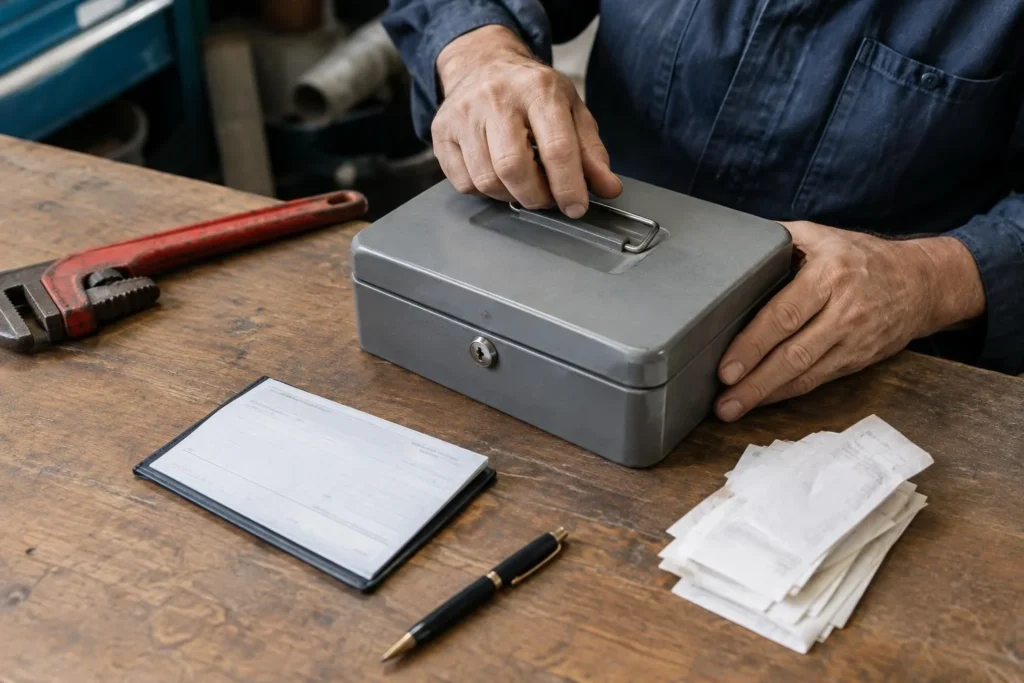
Step 1: Choose the fund amount and custodian
- Review recent spending. Pull the last two to three months of bank and card statements. Flag every purchase that would normally be paid in cash, such as parking, postage, or small supplies.
- Size the fund for about one month. For example, a repair shop that spends roughly $100 to $130 a month on small cash purchases could set the fund at $150. That covers a normal month with a small cushion, without keeping excess cash on site.
- Name one custodian and one backup. The custodian holds the box, pays out cash, and keeps the log. A single owner means one person is accountable for the balance. When several people dip into the box, nobody can explain a shortage. The backup steps in only during vacations or sick days.
Step 2: Write the check and lock the box
- Write the opening check. Make it payable to the custodian or to “Petty Cash” for the fund amount, such as $150.
- Record it in your books. In the general ledger, record this as a transfer from your bank account to a petty cash asset account. Debit Petty Cash $150 and credit Checking $150. No expense is recorded yet.
- Store the cash securely. Keep it in a locked cash box or a locked drawer. Only the custodian and backup should have keys.
- Post a short written policy. Keep it to one page. Include the maximum single payment (for example, $40), who may approve payments, and what’s excluded. Owner personal expenses, payroll advances, and loans to staff should never come from petty cash.
Using the Imprest System and Petty Cash Vouchers
How the imprest system keeps the balance honest
The petty cash imprest system means the fund always returns to its set amount. At any moment, the cash in the box plus the receipts for money spent should equal the fund total. If those two numbers don’t add up, something is missing.
Here’s the math with a $150 fund. The custodian pays $22.40 for postage and gets a receipt. The box now holds $127.60 in cash plus one receipt for $22.40. Together, they equal $150.00.
Your general ledger also stays at $150 in the petty cash account. That balance changes only if you deliberately raise or lower the fund size.
Writing a petty cash voucher for every payment
A petty cash voucher is a short form that documents each payment. You can buy pre-printed pads or make your own. Each voucher should include:
- Date and voucher number
- Amount paid
- Payee (the store or person paid)
- Purpose of the expense
- Expense account to charge, such as Postage or Office Supplies
- Name and signature of the person who received the cash
- Signature of the person who approved it
Staple the receipt to the voucher. Sometimes a receipt isn’t available, such as a cash tip to a delivery driver. In that case, write a note on the voucher explaining the expense and have the approver sign it. That’s better than nothing, though an original receipt is always stronger support.
This matters at tax time too. The IRS expects businesses to keep records that support their income and deductions. Confirm current recordkeeping rules for the 2026 tax year on the IRS Small Businesses and Self-Employed page, and check with a qualified tax professional about your situation.
Build a Petty Cash Log Template and Track Every Entry

Columns to include
The log is the running record of everything that happens in the box. Copy this petty cash log template into a spreadsheet or a bound notebook:
| Date | Voucher No. | Payee | Description | Expense Account | Amount Out | Cash In | Running Balance |
|---|---|---|---|---|---|---|---|
Each column has a job. Voucher No. ties the log line to its paper voucher. Expense Account tells your bookkeeper where the cost belongs. Cash In captures the opening deposit and each replenishment. Running Balance shows what should be in the box right now.
Sample log entry
Here’s what one month might look like for a $150 fund:
| Date | Voucher No. | Payee | Description | Expense Account | Amount Out | Cash In | Running Balance |
|---|---|---|---|---|---|---|---|
| Mar 2 | — | Business checking | Opening fund, check #1042 | — | — | $150.00 | $150.00 |
| Mar 4 | PC-001 | Post office | Certified mail to supplier | Postage and Delivery | $22.40 | — | $127.60 |
| Mar 9 | PC-002 | City parking garage | Parking for client meeting | Travel and Parking | $12.00 | — | $115.60 |
| Mar 15 | PC-003 | Local hardware store | Replacement door hinge | Repairs and Maintenance | $18.75 | — | $96.85 |
| Mar 22 | PC-004 | Grocery store | Coffee and creamer for break room | Office Supplies | $14.30 | — | $82.55 |
At any point, the custodian can count the box and compare it to the running balance. On March 22, the box should hold exactly $82.55.
To track petty cash consistently, follow three habits:
- Record each payment the same day. Memory fades fast, and a missing line is the most common cause of a shortage.
- Number vouchers in order. A gap in the sequence, such as PC-003 followed by PC-005, is an instant red flag.
- Never leave IOUs in the box. An IOU is an unrecorded loan. If someone needs cash for a purchase, they get a voucher and return the receipt and change.
The log then feeds your bookkeeping system. At month end, your bookkeeper uses it to post each expense to the correct account.
Petty Cash Replenishment: Calculating the Refill
The replenishment formula
Petty cash replenishment uses one simple formula:
Replenishment amount = Fund amount − Cash on hand
That number should equal the total of all vouchers since the last refill. When both methods give the same answer, your fund balances. If they don’t, stop and reconcile before writing the check.
Worked example
- Start with the fund amount: $150.00.
- Count the cash in the box: $41.85.
- Calculate the refill: $150.00 − $41.85 = $108.15.
- Total the vouchers: they add up to $108.15, which matches.
- Write a check for $108.15 payable to the custodian or Petty Cash. Cash the check and add the money to the box. The fund is back to $150.00.
Next, sort the vouchers by expense account:
| Expense Account | Vouchers | Total |
|---|---|---|
| Postage and Delivery | $22.40 + $25.20 | $47.60 |
| Travel and Parking | $12.00 + $15.50 | $27.50 |
| Repairs and Maintenance | $18.75 | $18.75 |
| Office Supplies | $14.30 | $14.30 |
| Total replenishment | $108.15 |
Here’s an important detail. Expenses are recorded when the fund is replenished, not when cash first leaves the box. The replenishment entry debits each expense account for the amounts above and credits Checking for $108.15. The Petty Cash account stays at $150.
Replenish on a set schedule, such as the last business day of each month. You can also refill early when the fund drops below a set level, like $40. Either way, never top up the box without vouchers to support the refill.
Monthly Petty Cash Reconciliation Checklist
Monthly checklist
A petty cash reconciliation confirms that cash plus vouchers still equals the fund. Run through this list at the end of each month, before you replenish:
- Count the cash in the box, including coins.
- Total all vouchers not yet replenished.
- Confirm voucher numbers run in sequence with no gaps or duplicates.
- Match each receipt and voucher to a line in the log.
- Check that each voucher has an approval signature.
- Add cash plus vouchers and compare the result to the fund amount.
- Have a second person review the count and initial the reconciliation.
- File the reconciliation with that month’s vouchers and log page.
What to do when the numbers do not match
Small differences happen. Start by recounting the cash. Then recheck each voucher amount against its receipt and the log. Many variances turn out to be a transposed number, like $18.57 logged as $18.75.
If you still can’t find the difference, record it honestly. Post the shortage or overage to a separate account, often called Cash Over and Short or Miscellaneous Expense. Say the box is $3.20 short. You would replenish $3.20 more than the vouchers total and charge that $3.20 to Cash Over and Short. Never cover the gap from your own pocket or bury it in another expense line.
A useful rule of thumb: a one-time short of a few dollars is usually a counting error. A short that repeats month after month signals a control problem, not bad luck. Review who has access and how payments are approved.
When possible, the custodian shouldn’t reconcile alone. A second check protects the business, and it also protects the custodian from suspicion if something goes wrong.
Small Business Cash Controls Beyond the Cash Box
Separation of duties
Strong small business cash controls rest on one idea: no single person should handle a transaction from start to finish. The person who holds the cash shouldn’t also approve payments or reconcile the fund. In a two-person office, the owner might approve and reconcile while an office manager serves as custodian.
Protecting the fund and your records
A few simple habits go a long way:
- Keep the box in one fixed, locked location.
- Limit keys to the custodian and backup.
- Store vouchers, logs and reconciliations with the matching monthly bank statements.
Keep petty cash records for as long as they may be needed for tax purposes. Retention periods vary by situation, so confirm current guidance for the 2026 tax year on IRS.gov or with your tax professional.
For broader financial management questions, SCORE offers free mentoring for small business owners. Search for SCORE online to find a mentor near you.
Start Your Petty Cash Fund This Week
You don’t need a perfect system to begin. First, pull the last 60 days of cash purchases from receipts, card statements, and reimbursement requests. Total them, then pick a fund amount that covers about a month of those small costs. Write the first check this week and record it in your books.
Next, print your petty cash log template and choose one custodian. Give them the cash box, a stack of vouchers, and clear spending limits. Then put the first monthly reconciliation on your calendar so it actually happens.
Note: Tax treatment and recordkeeping rules can change. Before filing for the 2026 tax year, confirm the details for your business with a qualified tax professional.
Related reading
- Cash Flow Forecast for Small Business: A Step-by-Step Guide
- Cash vs. Accrual Accounting: Which Method Fits Your Business?
Frequently Asked Questions
How much should a petty cash fund be?
Base it on your actual spending, not a round guess. Add up small cash purchases over recent months and size the fund to cover roughly one month. For example, $240 in cash purchases over 60 days averages about $120 a month, so a $150 fund leaves a small cushion. Keep it small enough that a loss wouldn’t hurt.
Can I use petty cash for owner personal expenses?
No. Petty cash is for business expenses only, and mixing in personal spending muddies your records. If personal money does leave the box, record it as an owner’s draw or distribution, not a business expense. Ask your accountant which account fits your business structure.
What do I do if the petty cash box is short?
Recount the cash, then match every voucher and receipt against the log. Look for missing slips, math errors, or a payment that never got logged. If the gap stays unexplained, record it to a “cash over and short” account and note it in the reconciliation. Repeated shortages are a sign to tighten controls or change custodians.
How often should petty cash be replenished?
Most small businesses refill monthly, or sooner if the balance drops below a set minimum. Always replenish at the end of an accounting period so expenses land in the right month. Each refill should be recorded with a journal entry that debits each expense category and credits your bank account.
Do I need a receipt for every petty cash payment?
Aim for one every time. The IRS expects businesses to keep adequate records to support their expenses. When a receipt isn’t available, have the person complete a signed voucher showing the date, amount, vendor, and business purpose. Staple any receipt to its voucher and keep both with the log.
A tidy petty cash fund is one small piece of clean books. If you’d rather hand off the reconciliations, journal entries, and month-end catch-up, SteadyBooks can help with bookkeeping, payroll, and everyday financial support. That way, you can spend your time running the business instead of chasing receipts.