

Minnesota Minimum Wage 2026: Rates and Employer Rules
Picture a bakery owner in Duluth who pays all her part-time staff the same hourly rate. She set that rate using Minnesota’s training wage for new workers under 20. Three months later, she discovers that one employee kept getting the lower rate long after the training period ended. That means back pay, a corrected payroll record and an uncomfortable conversation. The Minnesota minimum wage is simple once you know which rate applies. Getting that one decision wrong is what causes trouble.
Minnesota’s rules also differ from federal law in a few important ways. The state does not allow a tip credit. Its overtime threshold is not the federal one. It also publishes a new rate every year based on inflation.
This guide covers the 2025 and 2026 rates, which category your business falls into, how overtime works and what records you need to keep. Wherever a figure changes each year, we point you to the official source so you can confirm it.
Minnesota Minimum Wage Rates for 2026
Large and small employer tiers
For many years, Minnesota set two rates. Large employers paid one rate and small employers paid a lower one. That changed under state legislation passed in 2023. Beginning January 1, 2025, large and small employers pay the same minimum wage. The lower youth and training rates remain in place.
The 2026 statewide rate took effect January 1, 2026, after the annual inflation adjustment published by the Minnesota Department of Labor and Industry (DLI). It is $11.41 an hour for all employers, up from $11.13 in 2025. The youth and 90-day training wage rose to $9.31.
Minneapolis and St. Paul set their own higher minimums. In Minneapolis, every covered employer must pay at least $16.37 an hour in 2026. In St. Paul, large and macro businesses also pay $16.37, while smaller St. Paul employers follow a separate phase-in schedule with a step on July 1, 2026. If you have staff working in either city, use the city rate whenever it is higher than the state rate.
| Who it applies to | 2025 rate | 2026 rate (from Jan. 1, 2026) |
|---|---|---|
| All employers, statewide | $11.13 | $11.41 |
| Youth (under 18) and 90-day training wage (under 20) | $9.08 | $9.31 |
| Minneapolis (all employer sizes) | $15.97 | $16.37 |
| St. Paul large and macro businesses | $15.97 | $16.37 |
How annual adjustments work
Each year, DLI adjusts the minimum wage for inflation. It announces the new rate ahead of January 1. Current law caps the yearly increase. Confirm the cap and the inflation measure with DLI, because these details are set by statute and can be amended.
To find the change, subtract the 2025 rate from the 2026 rate:
- $11.41 − $11.13 = $0.28 more per hour
- For a worker averaging 25 hours a week: $0.28 × 25 = $7.00 more per week
Next, review every hourly wage in your payroll system. Any employee paid below the new minimum needed a raise effective January 1, 2026.
How to Tell Whether Your Business Is a Large or Small Employer
Minnesota has defined a small employer as a business with gross annual revenue under $500,000. Since 2025, both tiers pay the same state minimum wage. Even so, the classification still matters in two situations.
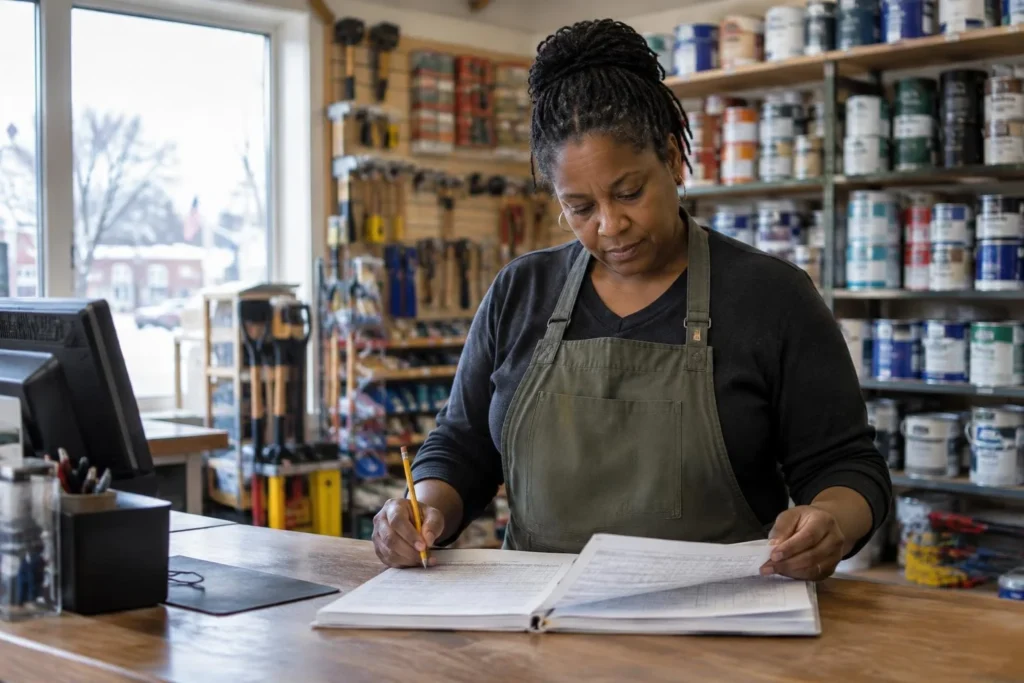
First, it affects any back-pay review that covers 2024 or earlier, when the tiers paid different rates. Second, $500,000 in annual gross volume is also the federal enterprise coverage test under the Fair Labor Standards Act (FLSA). That test helps decide whether federal overtime rules apply to your business. Confirm the current threshold, and how revenue is measured, with DLI.
Gross revenue is your total receipts from the business before any expenses. It is not profit. Here is an example. A shop with $520,000 in sales and $480,000 in costs earns $40,000 in profit. Its gross revenue is still $520,000, which puts it above the threshold.
Use this checklist to classify your business:
- Pull last year’s gross revenue. Use total receipts from your profit and loss statement, not net income.
- Check for a larger enterprise. Note whether your business is part of a franchise system or a larger company.
- Review affiliated entities. List any businesses that share owners, management or operations. Combined revenue may count.
- Record the review date. Write down when you made the classification and which figures you used.
Is your revenue close to $500,000? If so, save your calculation and the supporting reports. Then reassess every year, because one strong year can change your status.
Federal vs. Minnesota Minimum Wage: Which Rate Applies
The federal minimum wage under the FLSA is $7.25 per hour. It has not changed since July 2009, according to the U.S. Department of Labor’s Wage and Hour Division.
When federal and state rates differ, employees are entitled to the higher one. Minnesota’s rate is well above $7.25, so Minnesota employers pay the state rate.
Federal and state laws don’t replace each other. They apply at the same time. Where they differ on any rule, you follow the one that protects the worker more. That might mean a higher wage, a lower overtime threshold or stricter recordkeeping. The minimum wage is simply the easiest place to see this principle at work.
Also check for local rules. Minneapolis and Saint Paul set their own minimum wages, and those rates are higher than the state rate. Their rules also define employer size in their own way. If you have employees working in either city, check that city’s ordinance. Pay the highest rate that applies to the hours worked there.
One more check: minimum wage rules protect employees, not independent contractors. Before applying any of these rates, make sure each worker is classified correctly. Our guide on how to classify workers as 1099 or W-2 walks through the tests.
Tipped Employees, Youth Workers and Training Wages
Tipped employee rules
Minnesota does not allow a tip credit. Federal law lets employers count part of an employee’s tips toward the minimum wage. Minnesota law does not. You must pay servers, bartenders and other tipped staff the full state minimum wage before tips.
Tip credit rules are easy to misstate, so check DLI’s current guidance before you set tipped pay.
Tips belong to the employee. You can’t keep them, and you can’t use them to cover your wage costs. Minnesota also limits tip sharing. Confirm with DLI what pooling arrangements are allowed.
For each tipped employee, record two separate figures:
- the hourly rate you actually pay
- the tips the employee reports
Your hourly rate must meet the minimum wage on its own.
Youth and training wage rules
Minnesota allows a lower rate for two groups:
- Youth wage: for employees under 18.
- Training wage: for employees under 20, during their first 90 consecutive days of employment.
Confirm both rules on DLI’s website before relying on them.
The lower rate has firm limits. You cannot pay the youth rate after a worker turns 18. You also cannot pay the training rate after day 90 or to anyone aged 20 or older. Our Duluth bakery owner made exactly this mistake. Once the period ended, her employee was owed the full minimum wage for every hour worked after that.
Before hiring a young or tipped worker:
- Check eligibility against DLI’s current rules.
- Record the worker’s date of birth and hire date.
- Set a calendar reminder for the date the lower rate ends.
Minnesota Overtime Rules: The 48-Hour Threshold
Under Minnesota law, employers owe overtime at 1.5 times the regular rate for hours worked over 48 in a workweek. That threshold is higher than the federal one, and it surprises many new employers.
The FLSA sets overtime at 1.5 times the regular rate after 40 hours in a workweek. This applies to covered, non-exempt employees. Coverage can come from your business size, through the enterprise test described above. It can also come from an individual employee’s work, such as regularly handling goods or payments that cross state lines. As a result, a small business can still have employees covered by federal law.
When both laws apply, the more protective standard wins. For a covered employee, that means overtime after 40 hours, not 48. The state’s 48-hour rule sets the floor for employees that federal law does not cover.
Here is a quick way to think about it:
- Covered by the FLSA: overtime after 40 hours.
- Not covered by the FLSA but covered by Minnesota law: overtime after 48 hours.
Exempt status is a separate question. Some salaried employees are exempt from overtime, but only if their job duties and pay meet specific tests. A job title alone doesn’t make someone exempt. Confirm exemptions and coverage with DLI or the U.S. Department of Labor before treating anyone as exempt.
Worked Payroll Example for a Small Minnesota Business
Maple Street Goods is a fictional retail shop with annual gross revenue below $500,000. It pays one hourly employee the Minnesota minimum wage. This week, the employee worked 50 hours. Below, R stands for the 2026 state minimum wage of $11.41.

- Confirm classification. Revenue is under $500,000, so the shop is a small employer. Since 2025, small employers pay the same state rate as large employers. The employee is 24, so the youth and training rates don’t apply.
- Calculate regular pay. Under the 48-hour state rule, regular pay is 48 × R.
- Calculate overtime. The employee worked 50 − 48 = 2 overtime hours. Overtime pay is 2 × 1.5R = 3R.
- Add for gross pay. 48R + 3R = 51R. At the 2026 rate of $11.41, that’s 51 × $11.41 = $581.91.
Now assume the employee is covered by the FLSA. Overtime starts after 40 hours instead of 48:
- Regular pay: 40 × R = 40R
- Overtime pay: 10 × 1.5R = 15R
- Gross pay: 40R + 15R = 55R, or $627.55 at $11.41
The federal rule adds 4R to this week’s pay, which is $45.64 at the 2026 rate.
Gross pay is only the starting point. Next, you withhold federal and state income tax and FICA. You can confirm Minnesota withholding requirements with the Minnesota Department of Revenue.
Payroll and wage rules change often. Rates and thresholds in this article apply to the 2025 and 2026 tax years as noted. Confirm the details with DLI or a qualified payroll professional before you run payroll.
Earned Sick and Safe Time and Required Workplace Notices
Minnesota Earned Sick and Safe Time (ESST) took effect January 1, 2024. It requires most employers to provide paid leave. Employees generally earn at least one hour of leave for every 30 hours worked. The law also sets annual accrual limits and a cap on carried-over balances. Confirm the current accrual rate and caps with DLI, since the legislature has amended ESST since it began.
ESST is separate from Minnesota Paid Leave, the state’s insurance program for family and medical leave. Our guide to Minnesota Paid Leave for employers covers that program.
For each pay period, track:
- hours worked
- ESST hours accrued
- ESST hours used
- the remaining balance
Here is an example. An employee works 60 hours in a two-week period. At one hour per 30 hours worked, they accrue 2 hours of ESST.
Use this checklist for required notices:
- Labor law posters. Display the current Minnesota minimum wage poster and other required state posters, plus the federal FLSA poster.
- ESST notice. Provide the required sick and safe time notice and include the policy in your employee handbook if you have one.
- Notice at hire. Give new employees the written wage and employment notice Minnesota requires, and keep a signed copy.
- Annual refresh. Replace posters and notices when rates change, especially each January.
Finally, keep your payroll records for as long as Minnesota requires. These records include hours, rates, gross pay, deductions and ESST balances. Confirm the retention period with DLI. Federal rules apply as well, so review the IRS guidance for small businesses on payroll recordkeeping. When the two sets of rules differ, keep records for the longer period.
Confirm Your 2026 Rate Before the Next Pay Period
A short review now can prevent back-pay problems later. Work through these steps before you run your next payroll.
- Confirm the 2026 rates. Check the Minnesota Department of Labor and Industry (DLI) website for the current 2026 minimum wage. Also confirm whether a separate small-employer rate still applies.
- Verify your classification. Pull last year’s gross revenue and compare it to DLI’s current definitions.
- Review each worker’s eligibility. Note who is under 18 or in a qualifying training period. Remember that Minnesota does not allow a tip credit, so tipped staff earn the full minimum before tips.
- Update payroll software. Change pay rates, set overtime to the 48-hour threshold, and confirm that sick and safe time is accruing.
Set a review date before each pay period. Then do a second check when DLI announces the annual adjustment, which takes effect January 1.
Next, schedule a quick payroll audit with your bookkeeper or a qualified professional. They can confirm the tax and legal details that apply to your business.
Related reading
- Minnesota Sales Tax for Small Businesses: A Filing Guide
- Form W-4 Guide: How to Fill It Out and What Employers Do
Frequently Asked Questions
What is the minimum wage in Minnesota for 2026?
Minnesota adjusts its minimum wage each year for inflation. New rates take effect January 1. For 2026, the statewide rate is $11.41 an hour, and the youth and training wage is $9.31. Minneapolis requires $16.37, as do large and macro employers in St. Paul. Whatever the state rate is, it is well above the federal minimum wage of $7.25 per hour, and you must pay the higher of the two.
How do I know if my business is a small employer in Minnesota?
Minnesota has historically used annual gross revenue to separate large and small employers. Recent legislation changed this tiered structure starting in 2025. Check DLI’s current guidance to see whether a separate small-employer rate applies to you in 2026. Have your revenue figures ready when you check.
Does Minnesota require overtime after 40 hours or 48 hours?
Minnesota state law requires overtime after 48 hours in a workweek. However, most businesses covered by the federal Fair Labor Standards Act must pay overtime after 40 hours. When both laws apply, follow the rule that is more generous to the employee. Confirm which law covers your business with a qualified professional.
Can I pay a teen worker less than the regular minimum wage in Minnesota?
Minnesota allows a lower youth wage for workers under 18. It also allows a training wage for workers under 20 during their first 90 days of employment. Both rates are lower than the standard minimum, and they adjust over time. Confirm the 2026 amounts on DLI’s website and record each worker’s eligibility in your payroll files.
Does Minnesota require paid sick leave for employees?
Yes. Under Minnesota’s Earned Sick and Safe Time law, most employees accrue at least one hour of paid leave for every 30 hours worked. Minnesota also has a separate statewide Paid Leave program, with benefits beginning in 2026. For details on that program, read our guide to Minnesota Paid Leave requirements for employers.
Keeping up with rate changes, overtime rules and leave accruals takes steady attention. If you’d rather spend that time running your business, SteadyBooks can help with bookkeeping, payroll and day-to-day financial support, so your books stay accurate and your payroll stays current.
This article is general educational information based on rules for 2025, 2026, not tax, legal, or accounting advice. Rules and thresholds change, so confirm details for your situation with the IRS or your state agency, or with a qualified professional.





2 Comments